

Taxpayers Guide: How to Use the Federal Education Tax Credit
Redirecting Part of Your Federal Tax Bill for Student Scholarships

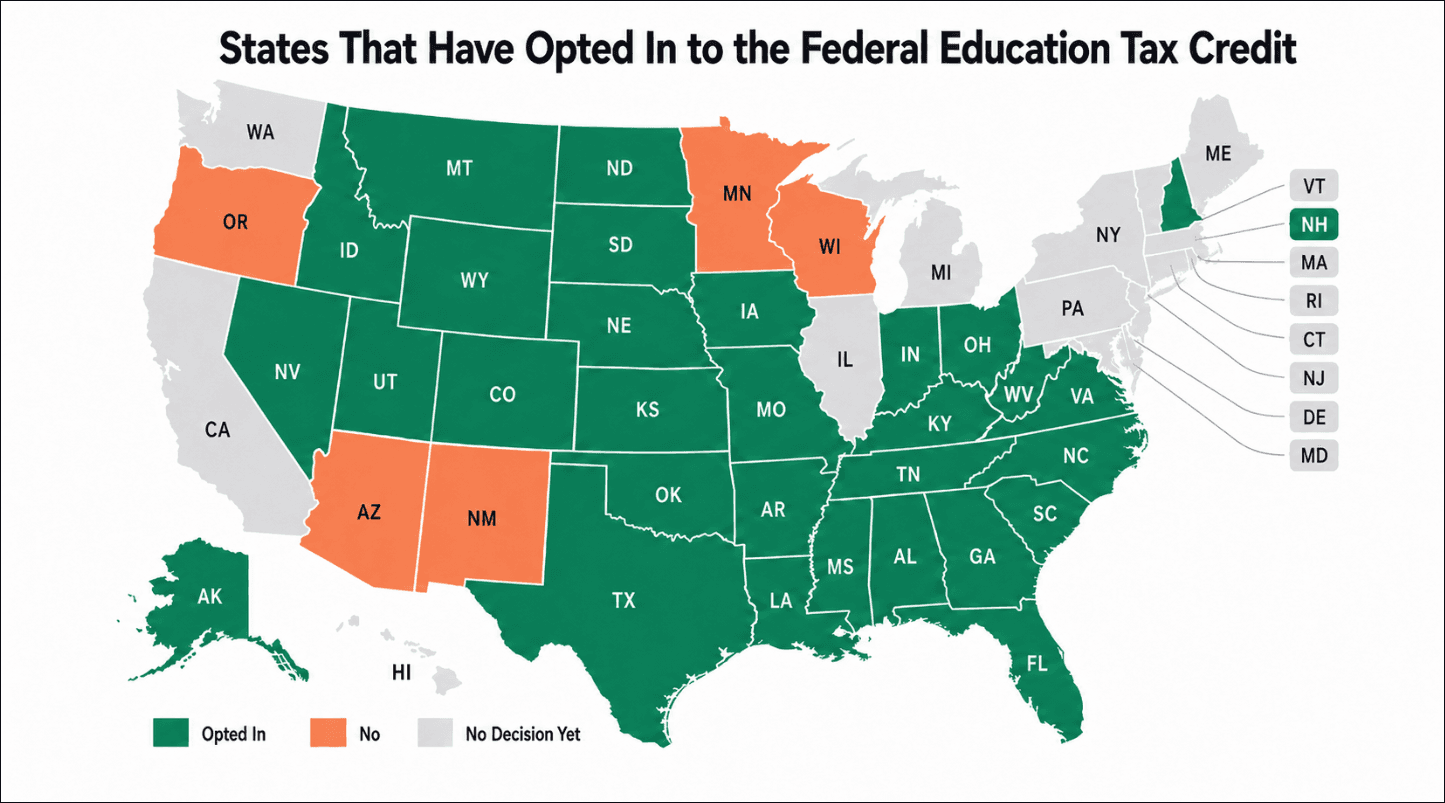
Update June 10th, 2026 -- The U.S. Department of Treasury provided initial guidance on the federal tax credit implementation, but final guidance on eligible expenses for scholarships is still expected in September of this year. The guide below provides potential expense uses based on information released thus far. We will provide more updates as Treasury provides more guidance.
Starting in the 2027 tax year, the new federal education tax credit allows each tax filer to claim a nonrefundable federal income tax credit of up to $1,700 per year for contributions to not-for-profit Scholarship Granting Organizations (SGOs), effectively redirecting that portion of their tax liability toward education scholarships rather than the general federal budget.
Important Note: Because it is a federal tax credit, you do not need to reside in a participating state to contribute and receive the tax credit. However, only opted in states and their approved SGOs are eligible to receive and distribute funds as scholarships to students residing in their states.
1. Understand how the credit works
Beginning with your 2027 federal return, you may claim a nonrefundable income tax credit of up to $1,700 per year for cash contributions to approved SGOs. The credit reduces your federal tax bill dollar for dollar, up to the $1,700 limit or your actual tax liability, whichever is less. SGOs use these funds to award scholarships to eligible students for “qualified elementary and secondary education expenses” instead of sending the money to a general government fund.
Federal law links “qualified” K–12 education expenses to the definition used for Coverdell and related accounts. Examples include:
Tuition and fees at public, private, or religious K–12 schools
Academic tutoring and educational therapies
Books, supplies, and required instructional materials
Technology, such as computers and internet access, used for schoolwork at home
Transportation and certain extended-day or enrichment programs required or provided by schools
This means the federal credit can support a child’s enrollment at a religious or secular private school, participation in a homeschool or microschool, or access to services in a district public school, depending on the SGO’s program design.
2. Choose where your tax dollars will go
You do not have to live in a particular state to donate there. For purposes of the credit, what matters is that:
The state has elected to participate in the federal scholarship program
The SGO you choose appears on that state’s official SGO list for the year
If your state participates, you can support SGOs that fund students in your community. If not, you may still claim the credit by donating to an approved SGO in another participating state, where your contribution will support students.
SGOs have diverse missions, which is a key strength of the program:
Some SGOs focus on helping students attend faith-based schools, primarily by providing scholarships for private religious school tuition and required fees.
Some emphasize homeschools, microschools, or hybrid schooling, using scholarships for tutoring, curriculum, educational therapies, and learning pods.
Some work directly with public schools, helping students access district-run tutoring, summer programs, enrichment courses, or specialized classes that public schools are well-positioned to offer.
If you prioritize public schools, you can select an SGO focused on supporting public school students through tutoring, intervention, and enrichment programs. If you prefer religious or home-based education, choose SGOs specializing in those areas. If you have no strong preference, many SGOs offer general-purpose scholarship funds to address the greatest needs across various school types and programs.
3. Make a qualifying contribution and keep records
To claim the credit, you must:
Make a cash contribution to an approved SGO in a participating state using either a bank account ACH withdrawal or a credit card payment.
If contributed via credit card, you will be assessed a surcharge for the % processing fee, which will be added to your contribution. The credit card fee cannot be covered in the tax credit and must be paid out-of-pocket.
Ensure your contribution is not earmarked for your own child or for any specific student
Receive and keep for your tax filing a receipt or acknowledgment from the SGO showing the date and amount of the contribution
Contributions must be made within the tax year you intend to claim the credit. As the credit is nonrefundable, it can reduce your tax bill but cannot result in a negative tax liability. Unused federal credit amounts may be carried forward for several future years, subject to Section 25F rules.
You can give to:
A single SGO whose mission you know and support
Multiple SGOs, dividing your contribution among different missions
A general or “greatest need” fund offered by an SGO, if you want them to decide how best to use your contribution among eligible students and expenses
In all cases, as long as the SGOs are approved and your contributions meet the requirements, the total amount you give (up to $1,700 per year) counts toward your federal credit.
4. Claim the credit on your tax return
When filing your federal return, enter your total qualifying contributions on the IRS-designated line or form for the federal scholarship tax credit. The credit will reduce your tax due, up to $1,700 or your actual tax liability, whichever is less. You may still itemize other deductions or claim other credits, provided you follow federal rules on double benefits and do not claim the same contribution twice, such as both a credit and a charitable deduction.
By following these steps, donors can convert part of their annual federal tax bill into direct support for students. This support may enable a child to attend a religious school, join a homeschool community, or receive specialized instruction in a public school. The federal credit can fund diverse missions, and donors and families have a direct opportunity to support those educational opportunities they care about most.