

Building Real Choice
Why strong public schools belong inside, not outside, school choice

As each of the 50 U.S. states joined the Union, they adopted constitutions mandating the creation and maintenance of public schools for residents, thereby establishing an explicit educational duty in state law. Initially, public schooling operated as a state and local enterprise: state clauses set the obligation, and local boards managed the schools. Over the latter half of the twentieth century, this arrangement evolved. Brown v. Board of Education established a federal civil rights mandate in education, while the Great Society and the Elementary and Secondary Education Act introduced significant federal funding streams with attached conditions. Subsequent legislation, such as No Child Left Behind, expanded federal oversight over the course of five decades. Currently, some of this top-down structure is being reversed as state-led education savings accounts (ESAs), vouchers, tax-credit scholarships, and other education freedom tools offer families increased choice in their children’s education.
Although education freedom policies are enjoying strong support nationwide, anti-school choice advocates warn that if choice wins out, public schools will deteriorate. The broader evidence, however, tends to show neutral or modestly positive effects on nearby public schools. The way that warning is framed can also distort the conversation on the other side: when public schools are treated as if they are beyond repair, it becomes easier for some proponents of choice to design a narrow, truncated version of reform that focuses almost exclusively on non‑district options and fails to build the infrastructure that fully incorporates public models. The result is a limited, ultimately weaker vision of choice, rather than a truly pluralist system in which public schools remain a central set of options that families can actively choose.
Public schools as a constitutional anchor in a choice era
Every state constitution mandates the establishment of a public education system. Some use wording such as “thorough and efficient” or “thorough and uniform” to mandate the existence of free public schools. Others make education the “paramount duty” of the state, or demand a “high-quality system of free public schools” available to all children. Public education is part of the constitutional architecture of American self-government and unlikely to go anywhere.
Many legal challenges to school choice programs are grounded in constitutional language. Opponents argue that directing public funds to private providers violates the state’s obligation to maintain public schools or contravenes older no-aid provisions. In states with especially robust education clauses, lawsuits have characterized ESAs and vouchers as direct threats to the public system, complicating administrators' and practitioners' efforts to design constructive, solution-oriented models of choice that retain public schools at the center of a wider ecosystem.
In most states, these constitutional challenges have struggled because courts and legislatures recognize that while maintaining a public school system is a non-negotiable state obligation, this does not require that all public funds be spent exclusively within district-run schools or that families be prohibited from allocating some funds to other authorized educational settings.
Where challenges to school choice policies have failed, they have done so because:
The state is still funding and operating a public school system at scale.
Aid to nonpublic schools is structured as aid to families or students, not as a direct subsidy to institutions.
The programs sit alongside, rather than replace, the public system.
Why public schools are more durable than anti-school-choice activists fear
Public schools have strengths that are real advantages in a choice-based ecosystem. For example, districts are the primary place where students with disabilities can access comprehensive support services: individualized education programs, specialized staff, therapies during the school day, and legal protections that families can enforce. Private schools that participate in voucher or ESA programs often operate under fewer obligations.
Then there is accountability and transparency. Public schools operate under systems that many states are still considering for private schools receiving public funds. Districts adhere to state standards, administer state assessments, publish public report cards, comply with open meeting laws, and meet fiscal transparency requirements. Their performance and spending are, by design, visible. In many states, the current school choice fight is not just “should there be vouchers?” but “what accountability should apply to private providers accepting public funds?” Some advocate for parity with public schools, while others fear such measures could diminish the distinctiveness or bespoke nature of some private options. Regardless of the outcome, public schools begin from a position of strength due to their established accountability frameworks.
Scale matters too. Large districts can support magnet programs, language immersion tracks, career and technical education pathways, and integrated special-needs services that are not easy to replicate at smaller scales. A single comprehensive high school can offer dozens of courses, extracurricular activities, and support. Students who move from small private settings to larger public schools often describe the adjustment period as bumpy, but also talk about exposure to more diverse peers, new activities such as theater or sports, and a larger community that broadens their perspectives.
In a context where families have more choice, public schools are often the provider with the deepest infrastructure, the clearest public obligations, and the broadest set of programs.
ESAs, tax credits, and new public school opportunities
The mechanisms for distributing educational funds are evolving rapidly, and public schools possess more opportunities than the anti-school-choice narrative suggests.
In certain states, ESA funds may be applied toward part-time enrollment in public school courses, online public programs, or district-operated microschools. Some districts are piloting magnet programs, laboratory schools, or specialized academies intended to attract students utilizing ESA or scholarship funds. Additionally, there is increasing discussion about scholarship mechanisms that support transportation, dual enrollment, or targeted programs within public schools.
Parents are assembling the right mix of school placement, services, and supports for their child. Parents in online communities routinely describe weighing tuition costs, commute times, special needs supports, diversity, and academic difficulty, not just “public vs. private.” The districts that lean into these new sources of funding by clarifying their offerings and making it easy for scholarship-using families to understand how to enroll will not merely survive, but grow.
How public schools can play to win in a choice ecosystem
For public school leaders, the way forward is to use the substantial strengths they already have and build on the new tools available to compete on what matters most to families.
A few practical moves:
Clarify your value proposition and articulate your core strengths. For example, a comprehensive neighborhood school might state, “We are the place where your child can access the widest range of secular courses, clubs, district-based athletics, and supports, in a community which reflects the full diversity of this city.” Magnet or specialized programs can further emphasize their unique niches.
Treat transparency as an asset. District schools already publish performance data, comply with fiscal transparency rules, and are subject to definite legal obligations to serve all students. That is a trust-building advantage in a marketplace where not every provider is equally transparent.
Make choice infrastructure work for you. As ESAs, vouchers, and scholarships expand, families will rely on tools that help them understand where they can go, what it will cost, and what it will be like. Make sure your schools show up clearly in those tools. Make it obvious whether and how scholarship-using families can enroll in your programs, and what they get when they do.
Share authentic stories about students and families who choose your schools. For example, highlight a parent who transitioned from a small private school to a district program to better support a child with complex needs, or a family who remained in a neighborhood public school due to richer extracurricular offerings, greater diversity, or stronger community connections.
Where LearningSpring fits: making true choice possible for everyone
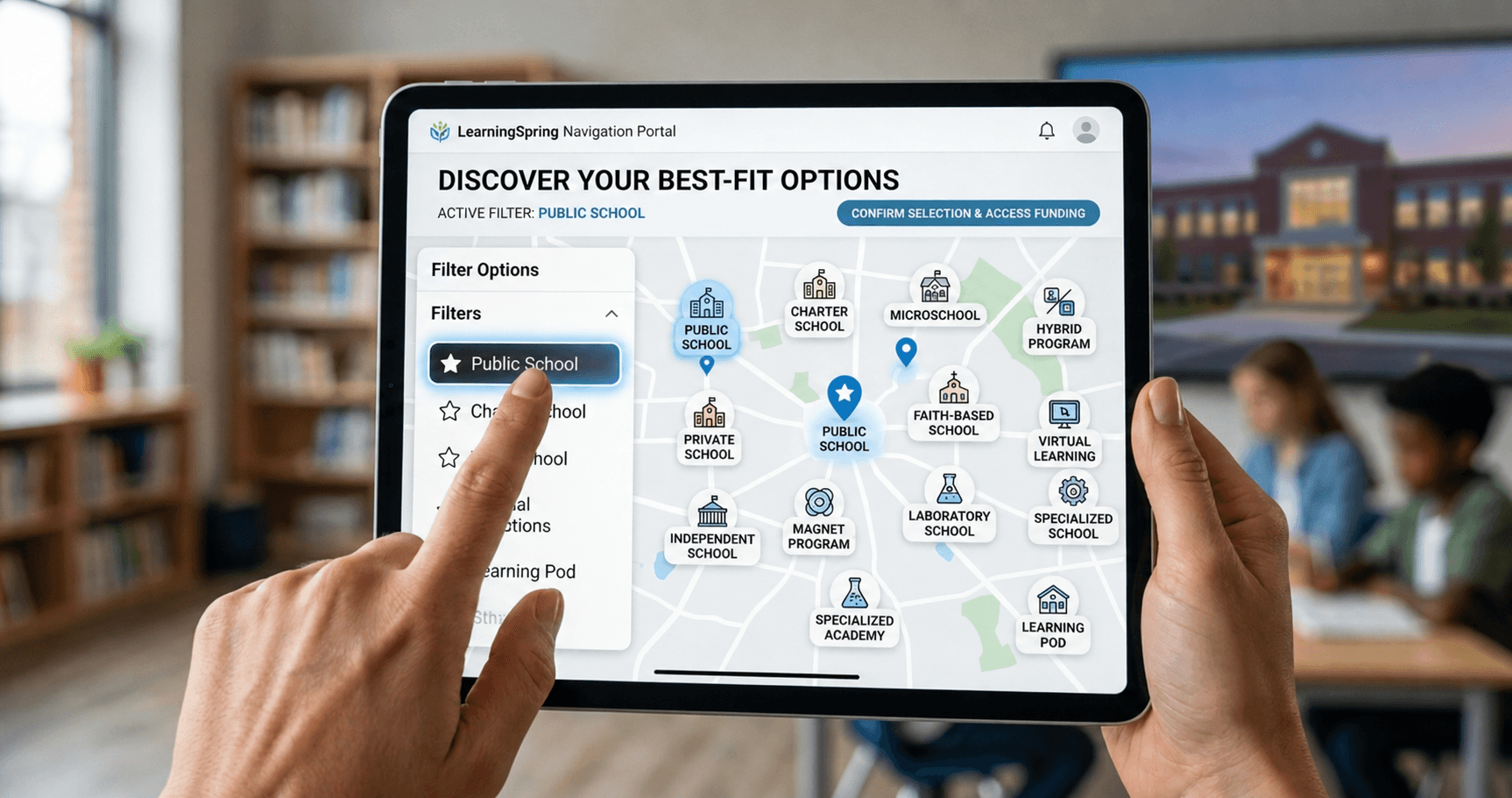
LearningSpring is building for a landscape in which public schools remain a central pillar amongst other expanding models, and where parents, not systems, are the primary navigators. Our north star is the parent and family. We want a system in which every family can see the full range of district schools, magnet, virtual, charter, faith-based, independent, micro, and hybrid, and understand the real trade-offs, costs, and constraints for each. We want them to discover their best-fit options first, then access eligibility and funding (where applicable) to enroll.
Transparency and accountability are core to our platform. We build program rules directly into the software to eliminate administrative burdens for parents, teachers, and school administrators. This approach enables genuine and sustainable educational choice.
We are unapologetically pro-public school for the same reason we are unabashedly pro-charter school, pro-microschool, and pro-hybrid: a healthy system needs as many strong, distinct options as possible, and the objective is to make it easier for every family, in every state, to select the school that best fits their needs, whether that is the neighborhood elementary school, a STEM magnet across town, a parish school nearby, or a small learning pod in a local community space.
School choice is now a reality, and public schools continue to play a vital role. LearningSpring exists to help families navigate this evolving educational landscape with clarity and confidence, both within and beyond the public system.